Your child wants to watch something. You want it to teach them about Allah, the prophets and good manners. So you search for Islamic videos for kids, and the results are a mix.
Some videos are lovely. Some have loud ads before they start. Some lead to a random cartoon two clips later. And a few are labelled “Islamic” but teach things you would never agree with.
This guide shows you where to find Islamic videos for kids, what to check before your child presses play, and which topics to look for at each age. It also shows how Kahf Kids makes the whole search easier.
You can find Islamic videos for kids in five places: regular YouTube, YouTube Kids, the websites and apps of Islamic kids creators, paid Islamic streaming apps, and Kahf Kids. YouTube has the most choice but the least control. Kahf Kids gives the most control, with 40,000+ videos that a dedicated mufti team reviews by hand before your child can see them.
What Makes a Good Islamic Video for Kids?
A good Islamic video for kids teaches something true, suits your child’s age, and plays in a place with no surprises around it. All three matter. A beautiful story about Prophet Yunus is not much help if an ad for a violent game plays first.
Look for these six signs:
- Correct content. Quran recitation is accurate. Hadith are real and sourced. Stories of the prophets stay close to what is known.
- Respectful portrayal. Many Muslim families do not want prophets or companions shown with faces. Good creators follow this carefully.
- Right for the age. Short and simple for toddlers. More story and detail for older children.
- Good manners on screen. Characters speak kindly, say salam and show adab. No rude jokes, no mocking.
- A clear lesson. Your child should be able to tell you what they learned in one sentence.
- A calm pace. Fast cuts and loud effects keep children hooked, but they make it harder to learn.
A note on music. Muslim families hold different views on musical instruments. Some are happy with nasheeds that use instruments. Others prefer vocal-only nasheeds, or voice with simple percussion. This guide does not give a ruling. Follow your family’s scholar, and check each channel’s style before you add it to your child’s list. Kahf Kids has a no-music option for families who want it.
5 Places to Find Islamic Videos for Kids
Islamic videos for kids live in five kinds of places. Each one gives you a different amount of choice and a different amount of control. Here they are, from the most open to the most controlled.
1. Regular YouTube
YouTube has more Islamic videos for kids than anywhere else. You will find cartoons, nasheeds, Quran recitation and prophet stories from creators around the world.
It is also where most children already watch. Ofcom’s 2026 Children and Parents media use report found that UK children aged 4 to 15 spend an average of 7 hours 7 minutes a week on YouTube, up 8% on the year before.
Good for: finding a specific series, or watching one chosen video together with a parent.
Watch out for: ads, autoplay, comments, and recommendations that can lead to random or harmful videos within minutes.
YouTube’s own terms set the minimum age at 13 in most countries. For the full picture, read why YouTube is a poor fit for young children.
2. YouTube Kids
YouTube Kids is a separate app for children. It has age settings for preschool, younger and older children. Parents can also turn off search and switch off autoplay.
The strongest setting is called “Approve content yourself”. With it on, your child sees only the videos and channels you pick, according to the YouTube Kids parental controls help page.
Good for: parents who have time to hand-pick every channel and check it regularly.
Watch out for: the default settings rely on automated filters that are not built around Islamic values.
In the default modes, music and themes you may not want can still appear. If you use it, choose “Approve content yourself” and keep search off.
3. Islamic Kids Creators’ Own Websites and Apps
Several well-known Islamic kids creators run their own platforms. For example, One4Kids, the makers of the Zaky series, offer their videos without ads on the One4Kids TV channel.
Good for: families who love one particular series and want it without YouTube around it.
Watch out for: each platform only has one creator’s work, so you end up paying for or juggling several apps.
4. Paid Islamic Streaming Apps
There are subscription apps that collect Islamic cartoons and shows from many studios in one place. They are usually ad-free and designed for Muslim families.
Good for: a larger library of Islamic shows with no ads.
Watch out for: review standards differ from app to app, and most do only one job. You still need separate tools to manage the rest of the phone.
Before you subscribe, ask who reviews the content and whether they are qualified in Islamic knowledge.
5. Kahf Kids
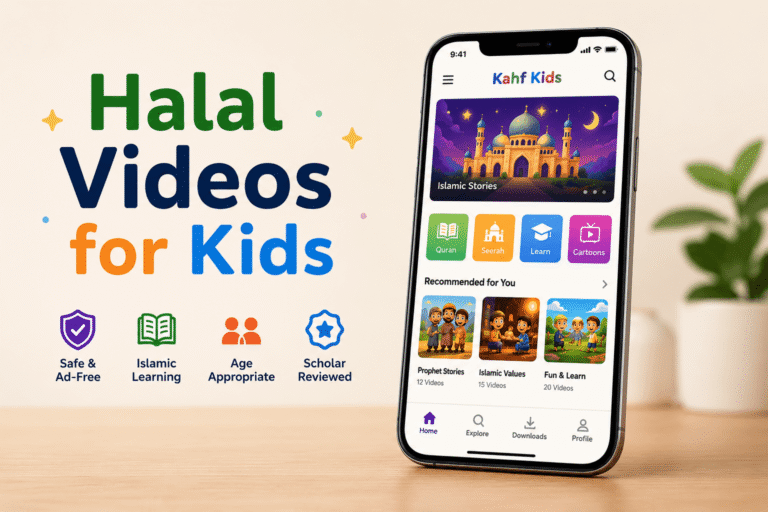
Kahf Kids puts mufti-reviewed Islamic videos for kids, learning tools and parental controls in one app. A dedicated mufti team reviews every piece of content by hand before it enters the library. Nothing gets in on an automated check alone.
Good for: parents who want Islamic videos, Quran, duas and games in one safe place, with control over what their child watches and for how long.
Keep in mind: it works best when you spend a few minutes on setup first, choosing daily limits and which apps to block.
There is no open search, no algorithm pushing the next clip, no comments and no messaging. We cover it in full further down.
Where to Find Islamic Videos for Kids: Side by Side
The table below compares the five places on the things parents ask about most. Use it to decide where your child’s viewing should start.
| Where | Ads | Open search | Who picks the next video | Islamic review | Parental controls |
|---|---|---|---|---|---|
| Regular YouTube | Yes | Yes | Algorithm | None | Limited |
| YouTube Kids | Yes, with some limits | Can be turned off | Algorithm, or parent in approved mode | None | Yes |
| Creators’ own apps | Usually none | Within one creator | Parent or child | Creator’s own standard | Basic |
| Islamic streaming apps | Usually none | Within the app | App, often with recommendations | Varies by app | Some |
| Kahf Kids | None | No | Parent and reviewed library | Mufti team, by hand | Yes, plus app blocking |
Here is the simple rule. The more a platform decides for your child, the more you need to trust how it decides. For more on this, see our guide on how to find safe content for Muslim children.
Islamic Videos for Kids by Topic
Knowing where to look is half the job. The other half is knowing what to look for. These are the topics most Muslim parents want their children to learn from video.
Quran recitation and short surahs
Short surahs with clear recitation help children memorise by listening. Look for videos that show the Arabic text and repeat each ayah. Slow, calm recitation works better than videos packed with animation. Pair these with one of the Quran apps for kids for daily practice.
Stories of the prophets
Prophet stories teach tawheed, patience and trust in Allah. Good videos tell the story simply and stay close to the Quran. They do not show the prophets’ faces. The Zaky series, for example, has an animated story of Prophet Yunus. For more reading ideas, see our list of Islamic stories for kids.
Duas, wudu and salah
Children learn routines by watching them. Short videos on making wudu, praying salah, and saying duas before eating or sleeping are very useful from age four. Watch them together first, then practise straight after.
Manners and character (adab)
Series like Omar & Hana focus on everyday values: sharing, honesty, kindness to parents. The show is made by Malaysian studio Digital Durian and is aimed at children aged 2 to 6. Many episodes end with a hadith or a short surah.
Arabic letters and words
Alphabet songs and word videos build a base for reading the Quran later. Choose videos that say each letter clearly and show how it is written. A few minutes a day is enough for young children.
Nasheeds
Nasheeds make Islamic ideas easy to remember. Check the style against your family’s view on instruments. Many creators now publish vocal-only versions of their songs.
Allah’s creation and science
Videos about animals, space and the human body can link wonder to the Creator. This is a gentle way to show children that Islam and learning go together.
Ramadan and Eid
Seasonal videos help children feel excited about fasting, Laylatul Qadr and Eid. Start watching a week or two before Ramadan so the ideas feel familiar.
Looking for ideas without the music question? See our list of halal videos for kids.
Islamic Videos for Kids by Age
The right Islamic videos for kids change as your child grows. A three-year-old needs songs and repetition. A ten-year-old is ready for longer stories and real questions. Use this table as a starting point.
| Age | Best video types | Length per video | Parent role |
|---|---|---|---|
| Ages 2 to 4 | Short surahs, Arabic letters, simple dua songs, Allah’s creation | 2 to 5 minutes | Watch together every time |
| Ages 5 to 7 | Wudu and salah, manners cartoons, short prophet stories, Ramadan and Eid | 5 to 10 minutes | Choose the list, watch most together |
| Ages 8 to 10 | Full prophet stories, seerah, Arabic words, Islamic science | 10 to 20 minutes | Pick together, talk about each one |
| Ages 11 to 12 | Seerah series, companions’ stories, tafsir for children, short courses | 15 to 30 minutes | Agree the rules, check in weekly |
These are guides, not rules. You know your child best. For daily limits, see our guide to screen time for kids.
What to Check Before Your Child Watches Islamic Videos
A good video can still sit in a bad place. Before your child watches Islamic videos for kids on any platform, check what happens around the video as well as inside it.
- Ads. Does an ad play before or during the video? Ads for games and products often do not match your values.
- What plays next. Is autoplay on? Can the next video be something you have never seen?
- Search. Can your child type anything and get results?
- Comments. Can your child read or write comments?
- Title versus content. Does the video actually match its title and thumbnail?
- Time. Is there a way to stop watching after a set time, without a fight?
The flow below turns these checks into one quick decision.
If you keep answering “no” on the same platform, the problem is the platform, not the video. That is often the moment to move your child’s viewing somewhere safer. You can also block YouTube on your kid’s phone once a better option is ready. For the wider picture, read how to keep your child safe on the internet.
A Safer Way to Find Islamic Videos for Kids: Kahf Kids
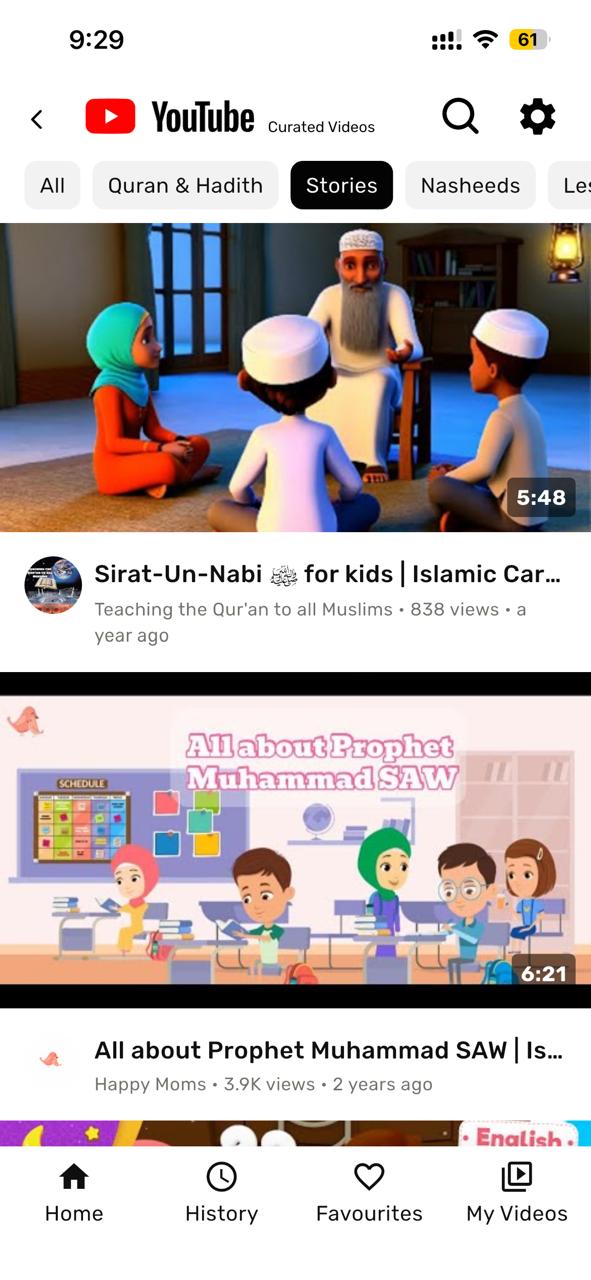
Kahf Kids brings 40,000+ mufti-reviewed Islamic videos for kids into one child-friendly app, with parental controls that help you manage what your child watches and how long they watch. You do not have to search, filter and double-check every clip yourself.
Every video is reviewed by a mufti team
This is the part that matters most. A dedicated mufti team at Kahf Kids reviews every piece of content by hand before it enters the library. They check the Islamic accuracy, the manners on screen and whether it suits children. Nothing passes on an automated check alone.
So when your child opens a video, someone qualified has already watched it for you.
Nothing leads your child away
Kahf Kids has no open search, no algorithm deciding what comes next, no comments and no messaging. Your child moves around a closed, reviewed library. There are no ads and no harmful recommendations. If your family avoids musical instruments, you can switch on the no-music option.
More than videos
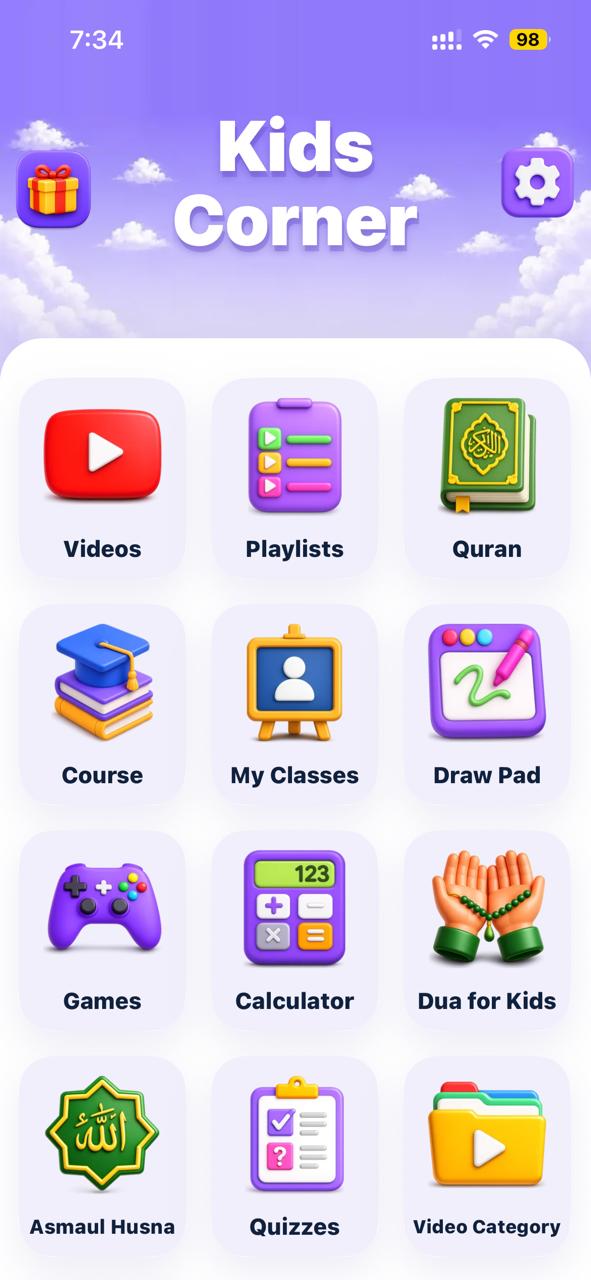
Inside the Kids Panel, your child can find:
- Videos, Shorts and Playlists across Quran and Hadith, stories, nasheeds, lessons, science, festivals and activities.
- Video Category so your child can browse by topic.
- Qur’an, Dua for Kids and Asmaul Husna sections for daily practice.
- Games and a Draw Pad for screen time that is not only watching.
- Course and My Classes, with structured lessons on Kahf Kids Learn.
- My Videos, where you can add videos you have chosen yourself.
You can get the app from the Kahf Kids website. It works on Android, iPhone, the web and smart TVs. The library comes in English and Arabic, including original Arabic series. That helps families who want their children to hear Arabic every day.
Parents stay in control
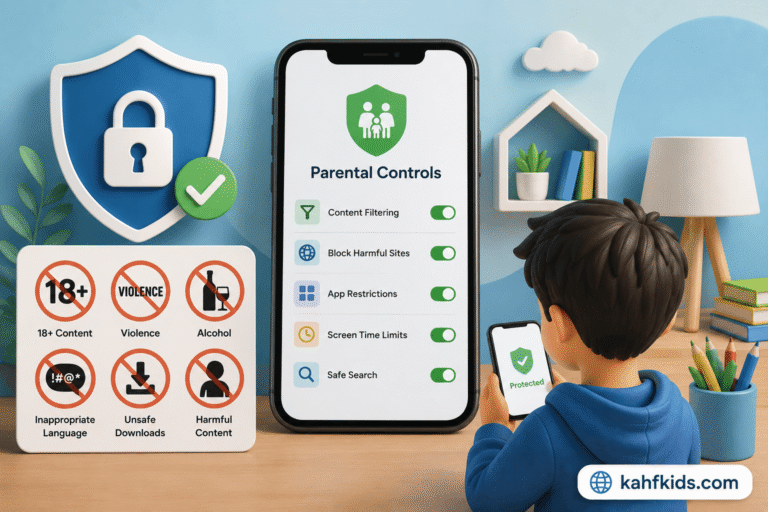
From the parent side, you set a daily screen time limit, and the phone locks itself when time is up. You can also block games, social media or any other app on your child’s phone, so YouTube and other video apps do not fill the gap. If you want to go further, read how to block haram content on your child’s phone.
Islamic videos your child can enjoy, and you can trust.
Every video in Kahf Kids is reviewed by a mufti team before your child sees it.
A Simple Routine for Islamic Videos for Kids at Home
The best Islamic videos for kids work even better with a small routine around them. Try these five habits:
- Pick a set time. For example, one short video after Asr. Children accept limits better when the time is always the same.
- Watch the first one together. See how your child reacts, and answer their questions.
- Ask one question after. “What did you learn?” or “What would you do if you were Omar?”
- Practise what they saw. If the video was about wudu, make wudu together straight after.
- End with something off the screen. A story book, a walk or helping in the kitchen.
If your child finds it hard to stop watching, our guide to YouTube addiction in kids has practical steps. You can also learn the signs of digital addiction in children and how to handle screen time addiction. Teaching at home? Our guide to Islamic homeschool resources shows how videos fit into a school day. You can also compare the best Islamic apps for kids.
Common Questions About Islamic Videos for Kids
Where can I find free Islamic videos for kids?
Regular YouTube and YouTube Kids have the most free Islamic videos for kids. Many creators, such as the makers of Omar & Hana and Zaky, upload episodes there. Free options come with ads and recommendations, so use YouTube Kids with “Approve content yourself” turned on, or watch together.
Is YouTube Kids safe for Islamic videos?
YouTube Kids is safer than regular YouTube, but its default filters are automated and not built around Islamic values. The safest setting is “Approve content yourself”, where your child only sees channels you choose. A mufti-reviewed library such as Kahf Kids removes the need to check every video yourself.
What age should children start watching Islamic videos?
Many families start with short Quran and dua videos around age two or three, watched together with a parent. Keep each video to a few minutes at that age. Longer stories and seerah work better from age seven or eight.
Finding good Islamic videos for kids should not take hours of searching. Pick one safe place, set a simple routine, and let your child enjoy learning about their deen. Good videos are one small part of raising righteous Muslim children.