
Islamic stories for kids are true stories from the Quran and the life of Prophet Muhammad (Sallallahu alaihi wasallam – may Allah honor him and grant him peace) that teach children values like honesty, patience, kindness, and trust in Allah.
The best ones are told in full, so a parent can read them aloud, and they stay faithful to the exact words of the Quran and authentic hadith.
Below are 25 stories. Each one is written as a complete story you can tell at bedtime, not a summary.
What are Islamic stories for kids?
Islamic stories for kids are moral stories from the Quran, the life of Prophet Muhammad (Sallallahu alaihi wasallam), and the lives of his companions. They teach children about Allah, good character (akhlaq), and how to make good choices, through a story instead of a lecture.
There are three main kinds. Prophet stories come from the Quran, Sunnah and companion stories come from authentic hadith, and values stories are the same events sorted by the lesson they teach.
A good story for children keeps every event true to its source, holds a child’s attention, and ends with one clear lesson.
Why Islamic stories matter for children
Children remember stories far better than rules. When a lesson lives inside a story, it becomes part of how a child sees the world.
These stories give children three things at once: good character, pride in their faith, and love for Allah and His Prophet (Sallallahu alaihi wasallam). And because they are real, found in the Quran and authentic hadith, they carry a weight that invented tales never do.
How to tell these stories so children love them
You do not need to be a scholar to tell these stories well. A few simple habits make all the difference:
- Set the scene first. Start with “A very long time ago…” and let your child picture the desert, the sea, or the crowd.
- Slow down at the big moment. Lower your voice at the fire, the whale, or the giant, so your child leans in.
- Read the “Source” line. Your child hears the real words and learns the story is true.
- Name the value plainly: “This is what patience looks like.”
- Ask the “Talk about it” question and let them answer in their own words.
Part 1: 10 Prophet stories from the Quran for Kids
These ten stories come straight from the Quran. Each is told in full so you can read it aloud, and each ends with the exact verse it is built on.
1. Prophet Adam (AS) and the first mistake
A very long time ago, before there were cities or schools, Allah created the first human being. His name was Adam (AS), peace be upon him.
Allah taught Adam (AS) something no creature had ever known: the names of everything. Then He gave Adam and his wife, Hawwa, a home in a beautiful Paradise. “Eat freely from wherever you like,” Allah told them. “But do not go near this one tree.”
Shaytan could not bear to see them so happy. He came whispering, quietly and cleverly, day after day. “That tree is the secret to living forever,” he said, until at last they forgot the warning and ate from it.
The moment they did, their hearts sank. But they did not make excuses or blame Shaytan. They turned straight to Allah, full of sorrow, and said the words the Quran still teaches us today.
Allah, the Most Forgiving, forgave them at once. That is how much He loves it when we come back to Him.
Source: “They said, ‘Our Lord, we have wronged ourselves, and if You do not forgive us and have mercy upon us, we will surely be among the losers.’” — Quran, Surah Al-A’raf 7:23
The lesson: Everyone makes mistakes, even the first human. What matters is admitting it honestly, without blaming others, and asking Allah to forgive us.
Talk about it: What is the first thing you should do the moment you realise you did something wrong?
2. Prophet Nuh (AS) and the great ship
Long ago there lived a prophet named Nuh (AS), peace be upon him. His people had forgotten Allah and started praying to statues they had carved themselves.
Nuh (AS) taught them gently, by day and by night, for hundreds of years. “Worship Allah alone,” he told them. “He made the sky above you and the earth beneath you.”
But most people laughed and covered their ears, and only a few believed.
Then Allah gave Nuh an unusual command: build a huge ship, far from any sea. The people walked past and mocked him.
“An old man building a boat in the desert! Where is the water?”
Nuh (AS) kept building anyway, trusting Allah more than he cared about their laughter. When the ship was ready, the sky went dark and the rain came down like nothing anyone had seen.
Nuh (AS) gathered the believers and a pair of every animal, and they climbed aboard. The water rose and rose, the ship floated safely, and those who had refused to listen were not saved.
Source: “And he was constructing the ship, and whenever an assembly of the eminent of his people passed by him, they ridiculed him. He said, ‘If you ridicule us, then we will ridicule you just as you ridicule.’” — Quran, Surah Hud 11:38
The lesson: Keep doing what is right, even when everyone around you laughs. Patience and trust in Allah win in the end.
Talk about it: Have you ever kept doing the right thing even when friends teased you? How did it feel?
3. Prophet Ibrahim (AS) and the fire that turned cool
In a busy old city lived a bright young man named Ibrahim (AS), peace be upon him. Everywhere he looked, people were bowing to idols they had carved with their own hands.
Ibrahim asked them gently, “Do these statues hear you when you call? Can they help you, or hurt you?” The people had no answer, because deep down they knew the truth.
So Ibrahim made a plan to make them think. When the temple was empty, he broke all the idols except the biggest one. “Ask the big one who did it,” he told the angry crowd, “if he can speak.”
They knew a statue cannot speak or move, but instead of changing, their anger grew. They built an enormous fire and threw Ibrahim into it.
Ibrahim was not afraid, because his trust was in Allah. And Allah, who is in charge of everything, gave the fire a command. The flames became cool and safe, and Ibrahim sat in the middle of the fire completely unharmed.

Source: “We said, ‘O fire, be coolness and safety upon Ibraham.’” — Quran, Surah Al-Anbiya 21:69
The lesson: Be brave in believing in one God, Allah. When you trust Him and stand for the truth, He protects you.
Talk about it: Ibrahim stood alone against a whole city. What does it mean to be brave for what is right?
4. Prophet Ismail (AS) and the great test of obedience
Ibrahim (AS) had prayed for years for a righteous son, and Allah blessed him with a wonderful boy named Ismail (AS), peace be upon him. They were the closest of friends, father and son.
One night, Ibrahim had a dream, and the dreams of prophets are true. In the dream, Allah asked him to sacrifice his beloved son.
Ibrahim trusted that Allah is wise and never asks for anything without a reason. So he gently told Ismail about the dream. And Ismail did not cry or run away.
He looked at his father with a calm, trusting heart and said he would be patient and obey Allah’s command. Two hearts, father and son, were ready to obey completely.
Just as they were about to carry out the command, Allah called out to stop them. It was never really about the sacrifice; it was about their willingness to obey. Allah sent a great ram instead, and today Muslims remember them every year on Eid al-Adha.
Source: “He said, ‘O my father, do as you are commanded. You will find me, if Allah wills, of the steadfast.’” — Quran, Surah As-Saffat 37:102
The lesson: Obey Allah and respect your parents, even when it is hard. Allah never asks us to do anything without a good and loving reason.
Talk about it: When is it hardest for you to obey? How can trusting that Allah is wise make it easier?
5. Prophet Yusuf (AS) and the brothers who came back
Yusuf (AS), peace be upon him, was a kind and gentle boy, deeply loved by his father, Prophet Ya’qub (AS), peace be upon him. But his older brothers grew jealous of that love.
One day their jealousy took over. They dropped Yusuf (AS) into a deep, dark well and told their father a wolf had eaten him.
A passing caravan found Yusuf (AS) and carried him far away to Egypt. Life there was hard. He was bought and sold, and later put in prison for something he did not do.
Through all of it, Yusuf (AS) stayed honest, patient, and close to Allah. Because of that honesty and the wisdom Allah gave him, he was finally set free and made one of the most powerful men in Egypt, in charge of the whole country’s food.
Then a famine came, and his brothers travelled to Egypt for food, not knowing the powerful minister was Yusuf (AS). When he finally told them who he was, they were terrified.
He could have punished them. Instead he forgave them completely, and his whole family was reunited with joy.
Source: “He said, ‘No blame will there be upon you today. Allah will forgive you; and He is the most merciful of the merciful.’” — Quran, Surah Yusuf 12:92
The lesson: Stay honest and patient through hard times, and forgive those who hurt you. Allah turns patience into something beautiful.
Talk about it: Yusuf (AS) forgave the brothers who hurt him most. Is forgiving easy or hard? Why do you think he chose it?
6. Prophet Musa (AS) and the mighty Pharaoh
In Egypt ruled a king so proud and cruel that he told everyone he was a god. His name was Pharaoh, and he treated the Children of Israel as slaves.
Allah chose Prophet Musa (AS), peace be upon him, to stand before him. Allah gave Musa clear miracles: his staff could become a living snake, and his hand could shine with light.
Musa (AS) walked into the grand palace and spoke the truth plainly. “There is only one God, Allah. Set my people free.”
Pharaoh refused, and chased Musa (AS) and the believers to the edge of a wide sea. Now they were trapped, with deep water in front and the army closing in behind.
The people panicked, but Musa stayed calm. “My Lord is with me,” he said. “He will guide me.”
Then Allah told Musa to strike the sea with his staff. The water split wide open into a dry path, the believers crossed safely, and when Pharaoh charged in after them, the sea closed over him.
Source: “[Musa] said, ‘No! Indeed, with me is my Lord; He will guide me.’” — Quran, Surah Ash-Shu’ara 26:62
The lesson: Allah helps those who believe in Him and stand against cruelty, no matter how powerful the wrongdoer seems.
Talk about it: What is the difference between being big and strong, and being right?
7. Prophet Yunus (AS) and the belly of the whale
Prophet Yunus (AS), peace be upon him, worked hard to teach his people about Allah, but they would not listen. One day he became so frustrated that he left the city before Allah told him it was time.
He boarded a ship, and a fierce storm rose up on the sea. In the chaos, Yunus (AS) ended up in the water, and a huge whale swallowed him whole.
Picture it: inside a whale, deep beneath the sea, in the dark and the silence. It was the loneliest place any person had ever been.
Yunus (AS) could have given up hope. Instead, in that darkness, he turned to the only One who could reach him there and called out to Allah with words the Quran still teaches us.
Allah heard him through the whale, the sea, and the dark. He forgave Yunus (AS) and commanded the whale to carry him to the shore and set him down safely.
Source: “There is no god except You; exalted are You. Indeed, I have been of the wrongdoers.” — Quran, Surah Al-Anbiya 21:87
The lesson: Never lose hope in Allah’s mercy, however dark things feel. Turn to Him in dua, because He always hears you.
Talk about it: Yunus made dua in the scariest place imaginable. What dua can you say when you feel scared or sad?
8. Prophet Sulayman (AS) and the little ant
Allah gave Prophet Sulayman (AS), peace be upon him, gifts no one else has ever had. He was a king and a prophet, and Allah taught him to understand the speech of animals.
One day his great army was marching through a valley. Down in the grass, a little ant saw them coming and called out a warning.
“O ants! Hurry into your homes, so that Sulayman and his soldiers do not crush you without noticing!”
Sulayman (AS) was a mighty king. He could easily have felt too grand to care about one ant in the dust. But when he heard the warning, he smiled.
He was delighted by the ant’s cleverness and care for its friends. Instead of feeling proud of his power, he thanked Allah and made sure the ants came to no harm.
Source: “Until, when they came upon the valley of the ants, an ant said, ‘O ants, enter your dwellings that you not be crushed by Solomon and his soldiers while they perceive not.’ So [Solomon] smiled, amused at her speech.” — Quran, Surah An-Naml 27:18–19
The lesson: Be kind to every creature, even the smallest, and always thank Allah for what He has given you.
Talk about it: A mighty king cared about one tiny ant. Name one small creature you can be kind to this week.
9. Prophet Dawud (AS) and the giant Jalut (Goliath)
Two armies stood facing each other across a battlefield. Leading one side was a cruel giant warrior named Jalut, or Goliath.
He was enormous, and his voice boomed across the field. “Who dares to fight me?” Not one soldier dared to step forward.
But in that army was a young man named Dawud (AS), peace be upon him. He was not big or the strongest, but his heart was full of faith.
While the others trembled, Dawud (AS) stepped forward to face the giant. The believers had prayed together: “Our Lord, pour patience upon us and make our feet firm.”
Dawud (AS) carried no giant sword, only a simple sling and a few stones, and complete trust in Allah. He swung the sling, and with Allah’s help, a single stone brought the mighty Jalut down.
The giant who had frightened a whole army was defeated by a young man who trusted Allah. Later, Allah made Dawud both a king and a prophet.
Source: “And when they faced Jālūt and his troops, they said: “Our Lord, pour out endurance on us, make firm our feet and help us against the disbelieving people.So, they defeated them by the will of Allah, and Dāwūd (David) killed Jālūt, and Allah gave him the kingdom and the wisdom and taught him what He willed. Had Allah not been pushing back some people by means of others, the earth would have been spoiled. But Allah is All-Gracious to all the worlds.” — Quran, Surah Al-Baqarah 2:250–251
The lesson: Real strength comes from faith in Allah, not from size or muscles. With His help, the small can overcome the giant.
Talk about it: What “giant” problem feels too big for you right now? How can trusting Allah help you face it?
10. Maryam (AS) and the miracle of Prophet Isa (AS)
Maryam (AS), peace be upon her, was one of the purest and most devoted women who ever lived. From a young age, she loved to worship Allah and spent long hours praying quietly.
One day, while she was alone, the angel Jibril came to her in the form of a man. He calmed her and told her he was a messenger from Allah with astonishing news: she would have a son.
“How can I have a son when I have no husband?” Maryam (AS) asked. The angel explained that this was Allah’s will, and for Allah nothing is difficult. When He wants something, He simply says “Be,” and it is.
So Allah blessed her with a baby boy, Isa (AS), peace be upon him. But this was a hard test too. When she returned to her people with a baby, some of them spoke unkindly to her.
Maryam (AS) did not argue. Trusting Allah, she simply pointed to her newborn. “How can we talk to a baby in the cradle?” the people scoffed.
Then came the greatest miracle. From the cradle, the infant Isa spoke clearly, and the people fell silent in wonder.
Source: “Spoke he (the baby), “Verily I am the servant of Allah. He has given me the Book, and made me a prophet,” — Quran, Surah Maryam 19:30
The lesson: Stay pure, patient, and trusting in Allah, even when others do not understand you. Nothing is impossible for Allah.
Talk about it: Maryam stayed calm when people doubted her. What helps you stay calm when things feel unfair?
Part 2: 10 stories from the life of Prophet Muhammad (Sallallahu alaihi wasallam) for Kids
These ten short stories are real events from the life of Prophet Muhammad (Sallallahu alaihi wasallam) and his companions, told in full. Each one ends with the exact hadith it comes from, and its reference, so you can trust it and look it up.
11. “Say Bismillah” — the boy who learned table manners
A young boy named Umar ibn Abi Salama grew up in the household of Prophet Muhammad (Sallallahu alaihi wasallam). One day they were all sitting together to eat.
Umar was just a boy, and his little hand was darting all over the dish, reaching for the tastiest pieces at the far end. The Prophet (Sallallahu alaihi wasallam) noticed.
He did not shout or embarrass the boy. Instead, gently, he taught Umar three simple rules he would remember for the rest of his life.
“Say the name of Allah before you eat,” he told him. “Eat with your right hand, and eat from the food nearest to you.”
Source: The Prophet (Sallallahu alaihi wasallam) said to me: “O boy, mention the Name of Allah, eat with your right hand, and eat from what is near you.” — Sahih al-Bukhari 5376; Sahih Muslim 2022
The lesson: Good manners are part of Islam. Begin with “Bismillah,” eat with your right hand, and eat from the food closest to you.
Talk about it: Which of these three eating manners will you practise at your very next meal?
12. The man who gave water to a thirsty dog
Prophet Muhammad (Sallallahu alaihi wasallam) once told his companions about a man on a long journey. It was a blazing hot day, and the man had no water left.
At last he found a well. He climbed down, drank his fill, and climbed back up feeling saved.
At the top, he saw a dog panting hard and licking the wet dirt, dying of thirst, exactly as he had been minutes before. He could have walked away, but he thought, “This poor animal is suffering just as I was.”
So he climbed all the way back down the well. He filled his leather shoe with water, held it in his teeth so he could climb, carried it up, and gave the dog a drink.
Allah was so pleased with this small act that He forgave the man’s sins. When the companions asked whether they were rewarded for kindness to animals, the Prophet (Sallallahu alaihi wasallam) said yes.
Source: “…a dog was panting and eating the moist earth from thirst. The man said, ‘This dog is suffering from thirst as I did.’ So he went down the well, filled his shoe with water, held it in his mouth, and watered the dog. Allah appreciated his deed and forgave him.”
They asked, “O Messenger of Allah, is there a reward for us in serving animals?” He said, “There is a reward in every living being.” — Sahih al-Bukhari 2363; Sahih Muslim 2244
The lesson: Kindness to animals is loved by Allah and brings great reward, even one drink of water for a thirsty creature.
Talk about it: How can you show kindness to an animal near your home this week?
13. The woman and the cat — a warning about cruelty
Prophet Muhammad (Sallallahu alaihi wasallam) told his companions another true story, but this one was a warning.
There was once a woman who had a cat. She locked it up and kept it trapped, giving it no food and no water.
She also would not let it go free, so the poor cat could not even hunt for itself. It was completely helpless in her hands.
Day after day the cat grew weaker, until at last it died. The Prophet (Sallallahu alaihi wasallam) taught that this cruelty was a very serious sin.
It is the opposite of the thirsty-dog story. Kindness to animals is rewarded, and cruelty to them, even by ignoring them, is a real wrong in the sight of Allah.
Source: “A woman was punished because of a cat which she had imprisoned until it died. She did not feed it, nor give it water when she confined it, nor did she release it so it could eat the vermin of the earth.” — Sahih al-Bukhari 3318; Sahih Muslim 2242
The lesson: Being cruel to an animal, even just by ignoring it and letting it suffer, is a serious wrong in Islam. Always care for the creatures in your charge.
Talk about it: Why do you think caring for a pet is such a big responsibility?
14. The strong person is the one who controls anger
One day the Prophet (Sallallahu alaihi wasallam) asked his companions a question. “Who do you think is the strong person?”
They answered the way most people would. “The strong one is the person who can wrestle everyone else to the ground!”
The Prophet (Sallallahu alaihi wasallam) gently surprised them. The truly strong person is not the one with the biggest muscles.
It is the one who, when anger boils up inside and he wants to shout or hit, holds it back and stays calm. That is real strength: not controlling other people, but controlling yourself.
Source: “The strong man is not the one who can overpower others (in wrestling); rather, the strong man is the one who controls himself when he is angry.” — Sahih al-Bukhari 6114; Sahih Muslim 2609
The lesson: Real strength is staying calm and controlling your temper, not winning fights.
Talk about it: What is one thing you can do to calm yourself down the next time you feel really angry?
15. The good deed that was hidden in the road
The Prophet (Sallallahu alaihi wasallam) told his companions about an ordinary man walking along an ordinary road. There was nothing special about the day.
As he walked, he noticed a branch full of sharp thorns lying in the middle of the path, where everyone had to pass. He stopped and thought about it.
“If I leave this here, someone might step on it and get hurt.” So he picked up the branch and moved it safely out of the way.
It took only a few seconds, and nobody saw him do it. But Allah saw, and He was so pleased with that quiet kindness that He forgave the man’s sins.
Source: “While a man was walking along a road, he found a thorny branch on the way and removed it, and Allah appreciated his deed and forgave him.” — Sahih al-Bukhari 652; Sahih Muslim 1914
The lesson: Even the smallest good deed matters to Allah. Making the world a little safer for others is charity, even when no one is watching.
Talk about it: What is one small good deed you could do today that quietly helps other people?
16. Smiling is charity
When we hear the word “charity,” we usually think of giving money. The Prophet (Sallallahu alaihi wasallam) taught his companions that charity is much bigger than that.
He told them that even a smile counts. When you smile warmly at another person, that kindness lifts their heart, and Allah writes it down as a good deed.
This means a child with no money at all can still give charity many times a day, simply by being warm and friendly to the people around them.
Source: “Your smiling in the face of your brother is charity for you.” — Jami’ at-Tirmidhi 1956 (graded hasan / good)
The lesson: A genuine, kind smile is an act of charity that anyone can give, any time, for free.
Talk about it: Who is someone you could cheer up with a warm smile today?
17. Anas ibn Malik (RA) – the boy who served the Prophet (Sallallahu alaihi wasallam) for ten years
When Anas ibn Malik (RA) was a young boy, his mother brought him to Prophet Muhammad (Sallallahu alaihi wasallam) to help and serve him. Anas served him for ten whole years.
Ten years is a long time. In all those years, a young helper is going to forget things, spill things, and make plenty of mistakes.
Yet when Anas (RA) grew up, he shared something amazing. In ten years, the Prophet (Sallallahu alaihi wasallam) never once scolded him.
He never even said the tiny word “uff.” He never said, “Why did you do that?” or “Why didn’t you do that?” Not once, in ten years.
Source: Anas (RA) said: “I served the Prophet (Sallallahu alaihi wasallam) for ten years, and he never said to me ‘Uff,’ and he never said about anything I did, ‘Why did you do that?’ or about anything I did not do, ‘Why did you not do that?’” — Sahih al-Bukhari 6038; Sahih Muslim 2309
The lesson: The best people are gentle and patient, especially with children. Be helpful and respectful, and be patient with others’ mistakes.
Talk about it: How does it feel when someone is patient with you instead of shouting? How can you do the same for others?
18. The little bird and the kind Prophet (Sallallahu alaihi wasallam)
The Prophet Muhammad (Sallallahu alaihi wasallam) was the leader of all the Muslims, with huge responsibilities. Yet he always made time for little children and noticed the small things that mattered to them.
A little boy named Abu Umayr, the young brother of Anas ibn Malik (RA), had a pet bird called a nughayr. He loved playing with his special friend.
One day the little bird died, and Abu Umayr was very sad, the way any child would be. The Prophet (Sallallahu alaihi wasallam) noticed his sadness.
He did not think he was too busy or too important to care. He would gently and playfully ask the boy, “O Abu Umayr, what did the little nughayr do?” and cheer him up.
Source: The Prophet Muhammad (Sallallahu alaihi wasallam) used to be kind and playful, and he would say: “O Abu Umayr, what did the little nughayr (bird) do?” — Sahih al-Bukhari 6129; Sahih Muslim 2150
The lesson: Be kind and gentle with children, and care about the little things that matter to them, even a small pet bird.
Talk about it: How can you be kind to a younger child in your family or class this week?
19. The honest merchant
In the old marketplaces, some sellers would hide the faults in what they sold to grab a little more money. A lie might earn an extra coin today.
The Prophet Muhammad (Sallallahu alaihi wasallam) taught his companions that honesty is worth far more than any extra coin. An honest, trustworthy trader tells the truth, keeps his promises, and never cheats.
He said such a merchant will be given one of the highest honours imaginable on the Day of Judgement. He will be raised up with the prophets, the truthful, and the martyrs, simply because he refused to lie for money.
Source: “The truthful and trustworthy merchant will be with the prophets, the truthful, and the martyrs.” — Jami’ at-Tirmidhi 1209
The lesson: Honesty earns people’s trust and Allah’s blessing, and it is worth far more than money gained by cheating. Never lie, even when a lie seems to help you.
Talk about it: Why do people keep coming back to someone they know they can trust?
20. Show mercy, and Allah will show mercy to you
The Prophet Muhammad Muhammad (Sallallahu alaihi wasallam) taught his companions a simple rule about kindness that even a small child can live by.
Allah is Ar-Rahman, the Most Merciful, and He loves mercy. The way we treat the creatures of the earth is connected to the way Allah treats us.
People who are merciful, kind to their brothers and sisters, gentle with animals, patient with friends, will have Allah be merciful to them. “Be merciful to those on the earth,” he said, “and the One above the heavens will be merciful to you.”
Source: “Those who are merciful will be shown mercy by the Most Merciful. Be merciful to those on the earth, and the One in the heavens will be merciful to you.” — Jami’ at-Tirmidhi 1924; Sunan Abi Dawud 4941 (graded hasan sahih)
The lesson: The way you treat others is the way Allah will treat you. Show mercy and kindness, and Allah will show His mercy to you.
Talk about it: Who is one person, or one animal, you can show extra mercy and patience to this week?
Part 3: 5 Stories about Honouring Parents
Honouring parents (birr al-walidayn) is one of the greatest acts in Islam. Allah places it right after worshipping Him alone. These five lessons come from the Quran and authentic hadith, each told in full.
21. Luqman’s loving advice to his son
The Quran tells us about a wise man named Luqman. One of the most precious things he ever did was sit with his son and give him loving advice.
That advice was so valuable that Allah recorded it in the Quran for all children, forever. Luqman began with the most important thing of all.
“My dear son,” he said gently, “never worship anything beside Allah. Worship Him alone.”
Then Allah reminds every child of something easy to forget. Think of how much your mother went through: she carried you inside her, growing weaker as you grew, and cared for you through sleepless nights.
That is why Allah’s command comes right after worshipping Him: be grateful to Me, and be grateful to your parents.
Source: “And We have enjoined upon man [care] for his parents. His mother carried him, [increasing her] in weakness upon weakness… Be grateful to Me and to your parents; to Me is the [final] destination.” — Quran, Surah Luqman 31:14
The lesson: Thank Allah first, and then thank your parents, especially your mother, who sacrificed so much to care for you.
Talk about it: What is one way you can thank your parents today, with your words or your actions?
22. Never say “uff” — Allah’s command to honour parents
In the Quran, Allah gives a command about our parents that is so clear you never forget it. When they grow old and need more help, we must be especially gentle with them.
Allah tells us not to say even the tiny word “uff” to them. “Uff” is just a small sound of annoyance, like a sigh, the sort we might make without thinking when asked to do a chore.
Allah says: not even that. Do not huff at your parents or speak to them harshly, but always speak with kind and respectful words.
He even teaches us a dua to make for them: “My Lord, have mercy upon them just as they cared for me when I was small.”
Source: “…say not to them [so much as] ‘uff,’ and do not repel them but speak to them a noble word. And lower to them the wing of humility out of mercy and say, ‘My Lord, have mercy upon them as they brought me up [when I was] small.’” — Quran, Surah Al-Isra 17:23–24
The lesson: Never be rude to your parents, not even with a small annoyed sound. Speak to them gently, and pray for them.
Talk about it: What is a gentle, respectful way to answer your parents even when you feel tired or grumpy?
23. “Your mother, your mother, your mother”
A man once came to Prophet Muhammad (Sallallahu alaihi wasallam) with a question. He wanted to know who most deserved his good treatment and kindness.
“O Messenger of Allah, who among people is most deserving of my good companionship?” The Prophet (Sallallahu alaihi wasallam) answered with one word: “Your mother.”
“Then who?” the man asked. “Your mother,” he said again. A third time the man asked, and a third time the answer was “Your mother.”
Only when the man asked a fourth time did the Prophet (Sallallahu alaihi wasallam) say, “Then your father.” He mentioned the mother three times before the father, showing just how much love and care she deserves.
Source: A man asked, “O Messenger of Allah, who is most deserving of my good companionship?” He said, “Your mother.” The man asked, “Then who?”
He said, “Your mother.” “Then who?” He said, “Your mother.” “Then who?” He said, “Then your father.” — Sahih al-Bukhari 5971; Sahih Muslim 2548
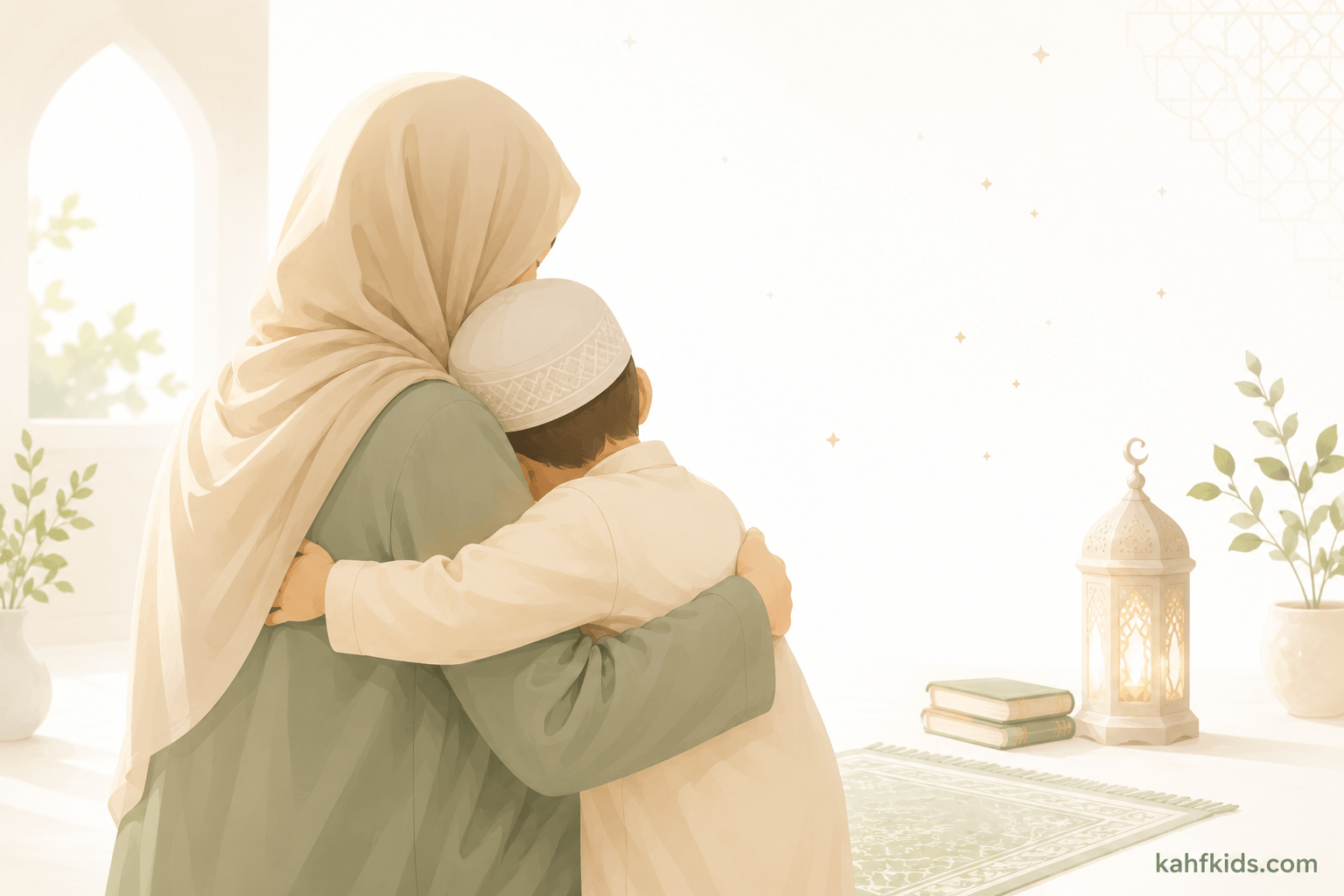
The lesson: Mothers deserve special love and care, and fathers deserve great respect too.
Talk about it: Why do you think the Prophet (Sallallahu alaihi wasallam) mentioned the mother three times before the father?
24. The young man who wanted to do a great deed
A young man once came to Prophet Muhammad (Sallallahu alaihi wasallam), eager to do something great for the sake of Allah. He wanted to go out and strive in Allah’s cause, and he was ready to leave home to do it.
Before letting him rush off, the Prophet (Sallallahu alaihi wasallam) asked a simple question. “Are your parents alive?”
“Yes, they are,” the young man said. And the Prophet (Sallallahu alaihi wasallam) told him something he may not have expected.
There is your great deed, he said. Go back and serve your parents. Caring for them is itself one of the greatest and most rewarding things you can do, a path that leads to Paradise, waiting right at home.
Source: A man came to the Prophet (Sallallahu alaihi wasallam) asking permission to go and strive [in Allah’s cause]. He asked, “Are your parents alive?” The man said, “Yes.” He said, “Then strive by [serving] them.” — Sahih al-Bukhari 3004; Sahih Muslim 2549
The lesson: Serving and caring for your parents is one of the greatest good deeds of all, a doorway to Paradise right in your own home.
Talk about it: What is one helpful thing you could do for your parents this week without being asked?
25. The greatest man helped at home
Prophet Muhammad (Sallallahu alaihi wasallam) was the leader of all the Muslims and the greatest human being who ever lived. If anyone could have said “housework is beneath me,” it was him.
But that was not the kind of person he was. His wife Aisha (RA) (may Allah be pleased with her) was once asked what he did at home with his family.
Her answer is a lesson for all of us. She said he was busy helping his family: mending his own clothes, doing ordinary chores, and taking part in the daily work like anyone else.
And when the time for prayer came, he would leave the housework and go out to pray.
Source: Aisha (RA) was asked, “What did the Prophet (Sallallahu alaihi wasallam) use to do in his house?” She said, “He used to be in the service of his family, and when the time for prayer came, he would go out for the prayer.” — Sahih al-Bukhari 676
The lesson: Helping your family with everyday chores is never beneath anyone. The greatest man who ever lived did it happily.
Talk about it: Which household chore can you cheerfully take charge of this week to help your family?
Story-and-value index (quick reference)
Use this table to quickly find a story for the value you want to teach today. Each story is matched to its main lesson and its authentic source.
| Story | Main value | Source |
| Prophet Adam (AS) | Admitting mistakes & repentance | Quran 7:23 |
| Prophet Nuh (AS) and the ship | Patience & perseverance | Quran 11:36–48 |
| Prophet Ibrahim (AS) and the fire | Courage & belief in one God | Quran 21:69 |
| Prophet Ismail (AS) and the test | Obedience to Allah | Quran 37:102 |
| Prophet Yusuf (AS) | Patience, honesty & forgiveness | Quran 12:92 |
| Prophet Musa (AS) and Pharaoh | Justice & courage against cruelty | Quran 26:62 |
| Prophet Yunus (AS) and the whale | Hope in Allah & making dua | Quran 21:87 |
| Prophet Sulayman (AS) and the ant | Kindness to animals & gratitude | Quran 27:18–19 |
| Prophet Dawud (AS) and Jalut | Faith over size or strength | Quran 2:250–251 |
| Maryam (AS) and Isa (AS) | Purity & trust in Allah | Quran 19:30 |
| The boy and food manners | Good manners (Bismillah) | Bukhari 5376 |
| Water for a thirsty dog | Mercy to animals | Bukhari 2363 |
| The woman and the cat | Avoiding cruelty | Bukhari 3318 |
| The strong person | Controlling anger | Bukhari 6114 |
| Removing harm from the road | Small good deeds count | Bukhari 652 |
| Smiling is charity | Kindness & charity | Tirmidhi 1956 |
| Anas serving the Prophet (Sallallahu alaihi wasallam) | Patience & gentleness | Bukhari 6038 |
| The little bird (Abu Umayr) | Gentleness with children | Bukhari 6129 |
| The honest merchant | Honesty in dealings | Tirmidhi 1209 |
| Show mercy to others | Mercy & compassion | Tirmidhi 1924 |
| Luqman’s advice | Gratitude to Allah & parents | Quran 31:14 |
| Never say “uff” | Speaking kindly to parents | Quran 17:23–24 |
| “Your mother” three times | Honouring your mother | Bukhari 5971 |
| Serving living parents | Parents as a path to Paradise | Bukhari 3004 |
| The Prophet (Sallallahu alaihi wasallam) helped at home | Helping the family | Bukhari 676 |
Sources & further reading
Every verse quoted above can be read in full, in Arabic and many translations, in the Quran online. Every hadith can be checked against the original Arabic and its grading in these authentic hadith collections.
Quran.com and Sunnah.com are the two most widely trusted online references for the Quran and the Sunnah. We encourage parents to look up any story they wish to verify.
More for Muslim parents from Kahf Kids
Beautiful stories build good character. In today’s world, protecting that character online matters just as much. Explore these parenting guides from the Kahf Kids blog: