You decide to homeschool your child. You search for help. You land on a list of forty links, half of them broken, and none of them tell you which one suits a six year old. That is the state of most Islamic homeschool guides online today.
This guide fixes that. It sorts Islamic homeschool resources into six clear categories. It shows you what is free and what costs money. It maps resources to your child’s age. It gives you a way to check any resource before you spend a rupee, a pound or a dollar on it. And it covers the legal step that most guides skip.
Islamic homeschool resources fall into six groups. Islamic studies and aqeedah. Quran and tajweed. Arabic language. Core academics such as maths and science. Adab, seerah and character. And the tools that hold the week together, including planners and safe screens. Most families need something from all six. Very few families need to buy all six.
What this guide covers
- What Islamic homeschool resources are
- Why Muslim families homeschool
- The six categories
- Free resources
- Paid resources and providers
- Resources by age and grade
- How to choose: a 5-check method
- Building a weekly schedule
- Quran and Arabic resources
- Safe screens
- Legal steps
- Mistakes to avoid
- Parent questions answered
What Are Islamic Homeschool Resources?
Islamic homeschool resources are the curricula, books, apps, worksheets and support tools that Muslim families use to teach children at home while keeping Islamic knowledge and character at the centre. They cover six areas: Islamic studies, Quran, Arabic, core academics, adab and seerah, and the tools that hold the week together.
That definition sounds simple. In practice, parents get stuck on one thing. They cannot tell the three types of resource apart.
A curriculum replaces school. It is sequenced. It runs for a full year. It tells you what to teach in week one and week thirty.
A supplement sits alongside something else. It might be twelve lessons on wudu. It is useful. It is not a school year.
A tool is neither. A planner is a tool. A safe video app is a tool. Tools do not teach a subject. They make the teaching possible.
Most wasted money in Islamic homeschooling comes from one mistake. A parent buys a supplement and expects a curriculum. Six weeks later the material runs out and the year has a hole in it.
Two ways to build the year
There are two common approaches, and both are valid.
The first is the integrated approach. Faith runs through every subject. A science lesson on the water cycle links to an ayah about rain. Providers such as Allamah Education build unit studies this way.
The second is the split approach. You use a mainstream core for maths, English and science. You add a separate Islamic studies and Quran block. Most families end up here, because strong secular maths curricula are easier to find than strong integrated ones.
Neither approach is more Islamic than the other. Pick the one you can actually run every week.
Why Muslim Families Turn to Homeschooling
Parents homeschool for two main reasons. They want a different environment for their child. And they want to teach values that a school day cannot fit in. Islamic homeschooling adds a third reason on top: Quran and Arabic time.
The numbers back this up. Pew Research Center reported in February 2025 that 3.4% of US K-12 students were homeschooled during the 2022-23 school year, up from 2.8% in 2018-19. In the same research, 75% of homeschooling parents said providing moral instruction was a reason for their choice, and 53% said providing religious instruction was a reason. Concern about the school environment was cited by 83%.
No reliable count exists for how many Muslim families homeschool in the US or the UK. Nobody collects that data by faith. Anyone who gives you a precise figure is guessing. What we can see is the demand side: new Islamic curriculum publishers, new online Islamic schools, and homeschool groups in most large Muslim communities.
Three reasons specific to Muslim families
Quran and Arabic need daily time. A school day plus a weekend madrasah gives a child a few hours a week. Homeschooling can give an hour a day, every day. Over a year that difference is enormous.
You control the social environment. This is not about keeping a child away from people. It is about choosing which influences arrive at which age.
Cost. Full-time Islamic school fees are high in most Western cities. A homeschool year with good resources usually costs a fraction of that.
There is a cost on the other side, and it is honest to name it. Homeschooling takes a parent’s hours. Usually a mother’s hours. Budget for that before you budget for books.
The 6 Categories of Islamic Homeschool Resources
Every working Islamic homeschool draws on six categories. You do not need to buy in all six. You do need to have a plan for all six.
1. Islamic studies and aqeedah
This is the foundation. Tawheed, the pillars, fiqh of worship, halal and haram. Look for material that states which school of thought it follows. Publishers such as Safar Publications, Learning Roots and IQRA International Educational Foundation produce graded sets for this.
2. Quran and tajweed
This splits into three jobs. Learning to read the script. Learning tajweed rules. Memorising and then revising. They are different skills and they need different slots in the week.
3. Arabic language
Also two jobs, and they are not the same. Quranic Arabic teaches a child to understand what they recite. Spoken Arabic teaches a child to talk to people. Pick one to lead with.
4. Core academics
Maths, English, science, history, geography. Any well-built curriculum works here. Check history and biology content against your values, then move on. Do not agonise over this category.
5. Adab, seerah and character
The part that is easiest to skip and hardest to replace. Seerah, stories of the prophets, manners, and the daily habits of the home. Much of this is caught rather than taught, but it still needs a slot on the timetable. Our guide on how to raise righteous Muslim children covers the habits that carry this category.
6. Tools: planners, trackers and safe screens
A homeschool planner. A Quran memorisation tracker. A record of hours, if your area asks for one. And the device your child learns on, which is a bigger decision than most parents realise. More on that below.
Free Islamic Homeschool Resources
You can build a complete primary-level Islamic homeschool without paying for curriculum. The free pool is strong for ages four to eleven. It gets thin for secondary level, and it is weakest for structured Arabic.
| Resource | What it covers | Best for ages | Format |
|---|---|---|---|
| Ihsaan Home Academy free lists | Islamic studies and Arabic link directories, sorted by grade | 6 to 16 | Link directory |
| Quranic Tarbiyah | Free Islamic curriculum and lesson resources | 5 to 12 | Downloads |
| Umm Assad Home School | Printable worksheets and activity sheets | 4 to 10 | Printables |
| Our Muslim Homeschool | Planning guides, starting steps, curriculum reviews | All ages | Articles |
| Crescent Moon Homeschool | Free curriculum roundups and kindergarten picks | 4 to 8 | Articles |
| Ummi Muslim Homeschool Planner | Downloadable weekly and yearly planner | Parent tool | Printable PDF |
| Islamic Curriculum Database (IELC) | Searchable hub of curriculum options | All ages | Database |
| Kahf Kids free courses | Animated Islamic lessons, duas and daily discoveries | 2 to 8 | Video course |
One free option worth naming in detail, because it is structured rather than scattered. Little Mu’min’s 30 Daily Discoveries on the Kahf Kids learning platform is a free, self-paced course for ages four to eight. It runs 31 animated lessons across six modules, each lesson three to nine minutes long. It covers Allah, the Quran, salah, wudu, the five pillars, Ramadan, the two Eids, and character topics such as patience and gratitude. For a family starting out, that is a ready-made first term of Islamic studies at no cost. The wider course library adds live online classes, Quran learning, dua learning and parenting courses, some free and some paid.
What Free Islamic Homeschool Resources Do Not Cover
Be clear about the limits before you build a year on free material.
- No accreditation. Free resources do not produce a transcript or a recognised qualification.
- No record keeping. If your local authority or school district asks for evidence, that is on you.
- No feedback. Nobody marks the work or tells you the child has a gap.
- No sequencing across years. Free packs rarely connect year one to year two.
- Mixed positions. Free material often does not state its aqeedah or fiqh position. You have to check.
- Link rot. Many popular free lists were written years ago. Expect dead links.
None of that means free is bad. It means free needs a parent who is willing to organise.
Paid Islamic Homeschool Resources and Providers
Paid options fall into three tiers. The right tier depends on one number: how many hours a week you can teach.
Tier 1: printed curriculum sets
You buy books. You teach. Publishers in this tier include Safar Publications, Learning Roots, IQRA International Educational Foundation, Goodword Books and Darussalam. Cost is low. Parent time is high. This tier suits a parent who enjoys teaching and has the hours.
Tier 2: structured programmes
You buy a sequenced programme with lesson plans and pacing already done. Allamah Education, Zaid Academy and Muslim Homeschool Hub sit here. You still lead the lesson, but you are not designing the year. This is the sweet spot for most families.
Tier 3: accredited online Islamic schools
A teacher leads. Your child attends classes. You supervise. Sahlah Academy offers accredited K-12 online schooling in the US. Everyday Ibaadah Academy runs virtual Islamic classes. In the UK, Crescent Pathways and Al-Rushd Online School teach the British curriculum with an Islamic frame. Cost is highest. Parent time is lowest.
| Tier | Who teaches | Parent hours per week | Accredited | Cost level |
|---|---|---|---|---|
| Printed curriculum sets | Parent | 15 to 25 | No | Low |
| Structured programmes | Parent, with plans supplied | 10 to 18 | Usually no | Medium |
| Online Islamic schools | Qualified teacher | 3 to 6 | Often yes | High |
On prices. Providers change fees often, and they differ by country and by year group. Check the current price on the provider’s own page before you commit. Treat any price quoted in a blog post, including a blog post that is not this one, as out of date.
Free or paid Islamic homeschool resources: how to decide
Use this rule. If you have more time than money, go free or Tier 1. If you have more money than time, go Tier 3. If you have some of both, Tier 2 gives the best return. Most families start free, hit a wall around age nine, and move up a tier.
Islamic Homeschool Resources by Age and Grade
A resource that delights a five year old bores a ten year old. Map by stage, not by what is popular.
| Stage | Islamic studies | Quran | Arabic | Screen guidance |
|---|---|---|---|---|
| Ages 3 to 5 | Short stories, duas, names of Allah, simple manners | Listening, short surahs by ear | Letter sounds, spoken words at home | Co-view only. Short sessions. |
| Ages 6 to 8 | Pillars, wudu, salah steps, prophet stories | Reading the script, first juz by memory | Reading letters, basic vocabulary | Reviewed library. No open search. |
| Ages 9 to 11 | Fiqh of worship, seerah in depth, hadith basics | Tajweed rules, steady memorisation and revision | Grammar basics, Quranic word study | Supervised research. Filters on. |
| Ages 12 to 14 | Aqeedah, why questions, comparative topics | Revision discipline, tafsir of memorised parts | Sarf and nahw, reading short texts | Device agreement in writing. |
| Ages 15 to 18 | Usul basics, ethics, contemporary questions | Consolidation, teaching younger siblings | Independent reading, classical texts | Gradual handover with review. |
Two notes on the Quran column. Memorisation pace varies enormously between children, and between siblings in the same house. The ranges above are a shape, not a standard. A child who is slower at hifz is not behind in deen. Our guide to Quran apps for kids compares tools that help with tajweed and revision.
How to Choose Islamic Homeschool Resources: A 5-Check Method
Run every resource through these five checks before you buy or download. It takes ten minutes and saves a term.
The five checks
- Check the position. Which school of thought does the material follow? Good publishers say so on the product page. If nobody says, ask.
- Check the author. Are the writers and reviewers named? Named scholars and teachers are the single biggest quality divider in this field.
- Check curriculum or supplement. Count the weeks of content. Under thirty weeks, treat it as a supplement.
- Check your time cost. Estimate the hours a week you must teach. Do this before you pay, not after.
- Check the screen. If it runs on a device, ask whether it has open search, autoplay, comments or recommendations. Any one of those puts your child one tap from content you did not choose.
Why check five matters most
The first four checks affect how well your child learns. The fifth affects what your child sees. A good Islamic app with an open recommendation feed can undo a whole morning of tarbiyah in ninety seconds. Test it yourself first. Open the app, tap around, and see how far you can get from the lesson.
Building a Weekly Islamic Homeschool Schedule
Most primary-age homeschools run four to five focused hours a day. That is less than a school day, and it is enough. School hours include registration, transitions, queues and crowd control. Your home has none of that.
Put Quran first. Minds are freshest in the morning, and memorisation rewards a fresh mind more than any other subject does.
| Block | Monday | Tuesday | Wednesday | Thursday | Friday |
|---|---|---|---|---|---|
| After Fajr | Quran: new | Quran: new | Quran: new | Quran: new | Quran: revision |
| Mid-morning | Maths | Maths | Maths | Maths | Maths games |
| Late morning | English | Arabic | English | Arabic | Free reading |
| After Dhuhr | Islamic studies | Science | Seerah | History | Jumuah, project |
Adapt it in three ways. With several children, teach Islamic studies, seerah and science to everyone together, and split only maths and reading. In Ramadan, move the whole day earlier and cut the afternoon block. And if a week collapses, which it will, protect the Quran slot and let the rest go.
Keep a simple record of what you covered each week. It takes two minutes. It matters for the legal section below.
Islamic Homeschool Resources for Quran and Arabic
These two subjects are where parents most often need outside help. They need different kinds of help, so treat them separately.
Quran resources
Reading and tajweed. A qaidah gives a child the script. After that, tajweed needs an ear. Apps help with practice, but a human ear catches what an app misses.
Memorisation and revision. The common mistake is treating new memorisation as the work and revision as optional. Flip that. Plan revision first, then add new lines with the time that is left.
Meaning. From about age nine, a child should know what the surahs they carry actually say. Short tafsir sessions on memorised passages do more for love of the Quran than adding more lines.
One-to-one tutors. Many families hire an online teacher for Quran. Vet them properly. Ask for an ijazah or a named teacher they studied under. Ask for a trial lesson. Sit in on the first month. Never leave a young child alone in a video call with an adult you have not verified.
Arabic resources
Decide the goal first. Quranic Arabic is about understanding a text. Spoken Arabic is about talking to people. The vocabulary lists barely overlap.
For most homeschooling families, Quranic Arabic is the better first goal. It compounds with the Quran work you are already doing. Spoken Arabic can follow later, and it will come faster once the grammar is in place.
Whichever you choose, daily beats weekly. Fifteen minutes a day will take a child further than two hours on a Saturday.
Safe Screens: The Islamic Homeschool Resource Most Parents Overlook
Here is something that surprises new homeschooling parents. Homeschooling usually increases a child’s screen hours, it does not reduce them. Lessons move onto a tablet. Research moves onto a browser. The device becomes the classroom.
So the device is part of your curriculum stack. Treat it that way.
What to require of any app your child learns on
- No open search. A search bar is a door to everything.
- No autoplay into unreviewed content. The lesson should end, not roll on.
- No comments. Comment sections are the fastest route to adult language.
- No messaging. Children should not be reachable by strangers inside a learning app.
- No algorithmic feed. A recommendation engine optimises for watch time, not tarbiyah.
Most mainstream kids platforms fail at least three of those. That is why we wrote about YouTube addiction in kids and the signs of digital addiction in children. Before you hand over any device, read our guide on how to keep your child safe on the internet.
The Kahf Kids app: Islamic stories and screen time control
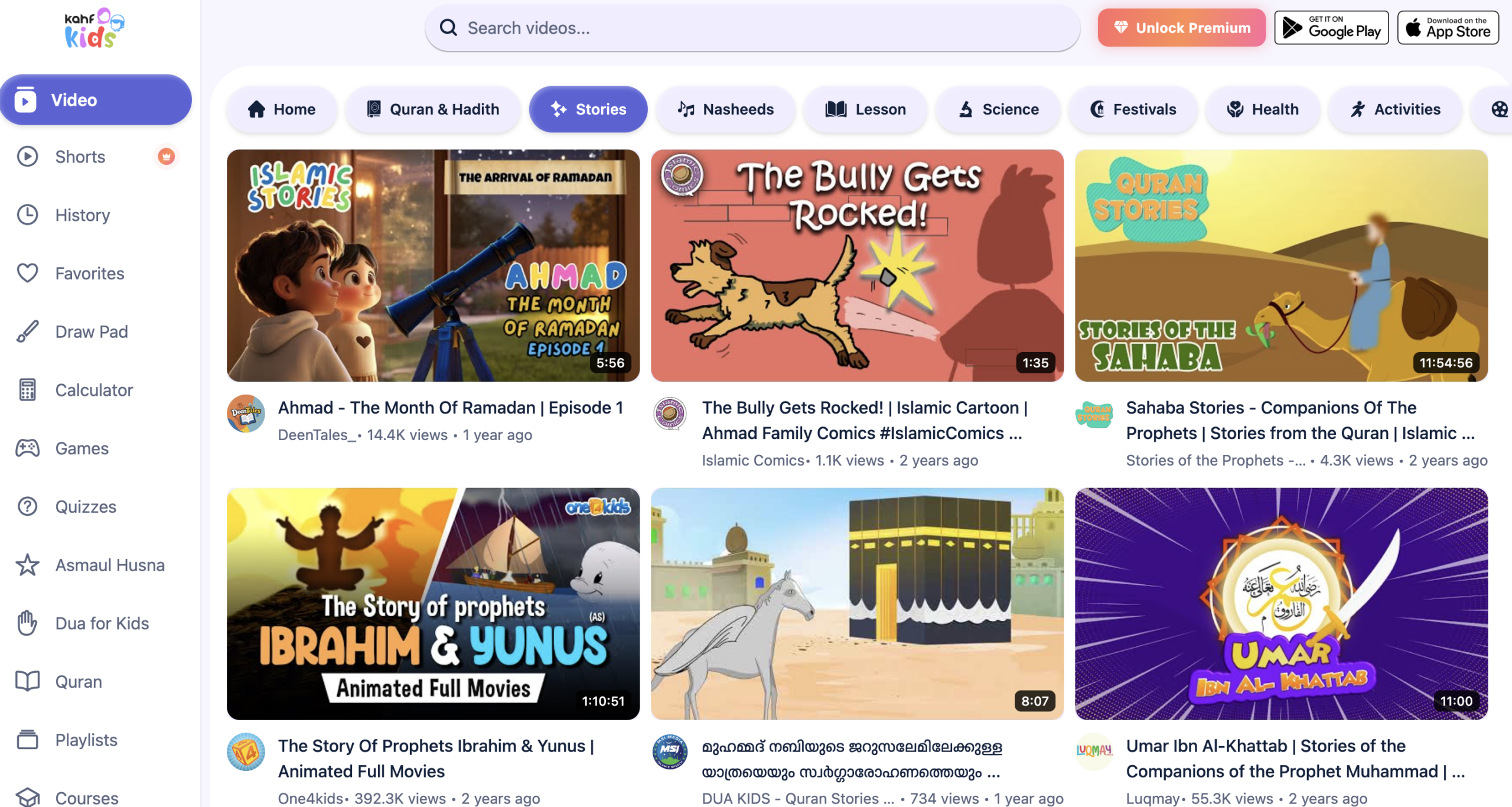
The Kahf Kids app does two jobs in a homeschool. It gives you a story and lesson library you can trust. And it gives you the screen time controls you need once lessons move onto a tablet.
On the content side, it was built to pass the five rules above. There is no open search, no autoplay into unknown content, no comments and no messaging. A dedicated mufti team reviews every single piece of content by hand before it enters the library. Nothing passes on an automated check. For a parent already carrying the teaching load, that removes a whole category of worry.
The library is organised by category: Quran and Hadith, Stories, Nasheeds, Lesson, Science, Festivals, Health and Activities. The Stories section is the one homeschooling parents use most. It covers prophet stories, seerah and character tales, which fills the adab and seerah slot on your timetable without you sourcing anything. Beyond video, the app includes Quran, Dua for Kids, Asmaul Husna, Quizzes, Games, Draw Pad and Courses. Separate Arabic and English libraries help directly if you are teaching Arabic at home.
On the control side, parents set what a child can open and how long they get. That matters more in a homeschool than in a school family, because the tablet is in the house all day. You decide the daily limit and the categories, and the child stays inside them.
Kahf Kids Courses: live classes, Quran, dua and parenting
Kahf Kids Courses is the structured side. It runs live online classes as well as recorded courses, so you can slot a real teacher into your week without building a school around it.
Four parts of it fit a homeschool directly.
- Live online classes. Scheduled sessions with a teacher, which covers the subjects you would rather not teach yourself.
- Quran learning courses. Guided recitation and Quran study, including free options.
- Dua learning courses. Duas taught through stories, which works well for ages four to eight.
- Parenting courses. Islamic parenting, child development, education strategy and digital parenting, for the parent who is also the teacher.
Several courses cost nothing. Little Mu’min’s 30 Daily Discoveries is the one to start with for ages four to eight.
For the hours outside lessons, set device-level controls too. Our step-by-step guides cover how to block haram content on your child’s phone and how to block Roblox. For the wider question of judging any content, see our guide to finding safe content for Muslim children, plus our lists of halal videos for kids and Islamic stories for kids. On limits, see how much screen time is healthy for kids.
Legal Steps Before You Use Islamic Homeschool Resources
Sort this before you buy a single book. Rules differ by country, and in one case they changed recently.
United States
Homeschooling is legal in all fifty states. What each state asks for varies a lot. Broadly there are four levels: states that require no notice at all, states that require notice only, states that require notice plus testing or assessment, and states with extra conditions such as parent qualifications or approved curricula.
Check your own state rather than trusting a summary. The Home School Legal Defense Association (HSLDA) publishes state-by-state homeschool law pages that are kept current.
England and Wales
Parents in England may still home educate. The law changed in 2026, so older guides are out of date.
The Children’s Wellbeing and Schools Act received Royal Assent on 29 April 2026. It requires every local authority to keep a Children Not in School register. It also restricts removing a child from school for home education in certain cases: where the child is under a child protection investigation, where the child is on a child protection plan or has been within the past five years, or where the child attends a special school. In those cases the local authority can refuse consent.
For everyone else the core duty is unchanged. Parents must provide a suitable, full-time education. The Department for Education publishes elective home education guidance for parents and local authorities. Check the current commencement dates for the register, because Royal Assent and full implementation are not the same thing.
Gulf states and elsewhere
Rules vary widely. Some countries do not recognise home education as a separate category at all, and expect a child to be enrolled somewhere. In those places, an accredited online school is usually the cleanest route, because it gives you an enrolment record and a transcript.
Confirm with your ministry of education before you start. Do not rely on what other parents in a group chat tell you.
Mistakes to Avoid With Islamic Homeschool Resources
Six mistakes account for most of the wasted money and most of the abandoned years.
- Buying a full curriculum before testing one subject. Run one subject for a month first. You will learn more about your child in that month than in any review.
- Stacking four programmes and finishing none. One Islamic studies programme, finished, beats four started. Finishing is the skill you are teaching.
- Treating Arabic and Quran as one subject. Reciting is not understanding. They need separate slots and separate materials.
- Downloading printables you will never print. A folder of 400 unprinted PDFs is not a curriculum. It is a hobby.
- Setting a hifz target that ignores revision. Memorisation without revision leaks. Plan revision first.
- Handing over a tablet with open search. The safest curriculum in the world does not help if the device beside it opens onto everything.
Common Questions About Islamic Homeschool Resources
What are the best Islamic homeschool resources for beginners?
Start with one Islamic studies programme, one Quran plan and one maths curriculum. Add nothing else for the first term. A free structured course such as Little Mu’min’s 30 Daily Discoveries covers the Islamic studies slot for ages four to eight without any cost.
Are there free Islamic homeschool curriculums?
Yes. Free options cover primary-age Islamic studies and Quran well. Ihsaan Home Academy, Quranic Tarbiyah and Umm Assad Home School publish free material, and Kahf Kids offers free video courses. Free options do not give accreditation, marking or record keeping.
Is Islamic homeschooling legal?
Homeschooling is legal in all fifty US states, with requirements that differ by state. It is legal in England, where the Children’s Wellbeing and Schools Act 2026 added a Children Not in School register held by local authorities. Rules in Gulf states vary, so confirm with your ministry of education first.
How much does an Islamic homeschool curriculum cost?
It depends on the tier. Printed curriculum sets cost the least and need the most parent time. Structured programmes cost more and supply the lesson plans. Accredited online Islamic schools cost the most and need the least parent time. Check each provider’s current fees directly.
What Islamic homeschool resources work for a 5 year old?
Short animated lessons, prophet stories, duas and the names of Allah. Keep sessions under fifteen minutes. Sit with your child rather than handing over the device. Formal reading and writing can wait.
Do I need an accredited Islamic online school?
Only if you need a transcript. Accreditation matters for university applications, for moving country, and for places where home education is not separately recognised. For primary years in the US or UK, most families do not need it.
How many hours a day should an Islamic homeschool run?
Four to five focused hours a day works for primary ages. Two to three hours is enough for children under seven. Homeschool hours are denser than school hours because there are no transitions or crowd control.
Can I homeschool if I do not speak Arabic?
Yes. Thousands of families do. Use a recorded Quran teacher or an online tutor for recitation, and learn alongside your child for the rest. Children respond well to seeing a parent learn.
How do I teach Islamic studies if I am not a scholar?
Use material written and reviewed by qualified people, and deliver it rather than invent it. Say “I do not know, let us ask” when you do not know. Keep a local scholar or imam you can send questions to.
Which Islamic homeschool resources are safe for a child to use alone?
Only ones with no open search, no autoplay into unreviewed content, no comments and no messaging. Test the app yourself before your child uses it, and see how far you can navigate away from the lesson.
How do I keep homeschool records?
Keep a weekly log of subjects covered, samples of work, and a reading list. Two minutes a week is enough. Store it in one folder. If your school district or local authority asks, you will have it ready.
Should I homeschool all my children the same way?
No. Teach Islamic studies, seerah and science together to save time. Split maths and reading by level. Siblings progress at different speeds, and that is normal.
Where to Start This Week
Do not try to build the whole year today. Do these four things instead.
- Check your local legal requirement and send any notice you owe.
- Pick one Islamic studies resource and one Quran plan. Nothing more.
- Write a four-block daily timetable on one sheet of paper.
- Run the five checks on every app your child will use, then remove the ones that fail.
Start small. Keep the Quran slot sacred. Add subjects only once the first ones are running without a fight. A homeschool that survives the year beats a perfect plan that collapses in November.