There is no single amount of screen time for kids by age that is right for every child. The World Health Organization recommends no screen time for children under age 2 and no more than one hour a day for children ages 2 to 4.
The American Academy of Pediatrics moved away from its old two-hour rule in January 2026. Parents should look at what children watch, when they use screens, how it affects sleep, and what other activities they miss because of screen use.
| Age | What the guidelines say | Source |
|---|---|---|
| Under 2 | Screen time is not recommended (video calls with family are an exception) | WHO |
| 2 years | No more than 1 hour a day, and less is better | WHO |
| 3–4 years | No more than 1 hour a day, and less is better | WHO |
| 5–18 years | No fixed limit. Judge by the 5 Cs: Child, Content, Calm, Crowding Out, Communication | AAP (2026) |
kahfkids.com
What Counts as Screen Time (And Why Not All of It Is Equal)
Screen time is any time your child spends looking at a screen: a phone, tablet, TV, computer, games console, or smart display. The total, on its own, tells you very little.
Three distinctions matter far more than the number of minutes:
- Educational content vs. passive entertainment
- Chosen viewing vs. autoplay and endless scrolling
- Age-appropriate content vs. something your child stumbled into
A 30-minute Qur’an lesson and 30 minutes of autoplaying YouTube Shorts are both “30 minutes of screen time.” Treating them as the same thing is why the hour count alone was never a useful measure, and it is why the AAP stopped using one.
Before you set any limit, it helps to know what your child can actually reach on the device. Our guide to safe internet for kids covers that groundwork.
How Much Screen Time Should Kids Actually Have?
It depends on your child’s age. For children under five, the WHO gives clear numbers. For school-age children and teenagers, the leading pediatric authority no longer gives a number at all.
What the WHO recommends for children under 5
The World Health Organization’s guidelines on physical activity, sedentary behaviour and sleep remain current, and they are specific:
- Under 1 year: screen time is not recommended.
- 1 year: screen time is not recommended.
- 2 years: no more than one hour a day, and less is better.
- 3 to 4 years: no more than one hour a day, and less is better.
The WHO pairs these limits with sleep targets and recommends reading and storytelling with a caregiver during quiet time instead.
Why the AAP no longer sets a screen time limit
In 2016, the American Academy of Pediatrics recommended a two-hour daily limit for older children. That number is still repeated everywhere. The AAP no longer recommends it.
In January 2026 the AAP published a new policy statement, Digital Ecosystems, Children and Adolescents, which replaced its numeric limits entirely. In the AAP’s own words:
“These evidence-based guidelines do not give a set screen time limit that applies to all children and teens… we recommend considering the quality of interactions with digital media and not just the quantity, or amount of time.” — American Academy of Pediatrics
The reason is straightforward. The 2016 figure was built on research into television viewing. It was never designed for a world where a screen is homework, a friendship group, a classroom tool, and an entertainment feed all at once.
What replaced it: the 5 Cs of Media Use
Instead of a clock, the AAP now asks parents to work through five questions, known as the 5 Cs of Media Use:
- Child — who is your child, and how does their personality shape what they are drawn to and how it affects them?
- Content — what are they actually watching, and does it carry violence, rude role-modelling, unrealistic beauty standards, or heavy commercialism?
- Calm — has a screen become their main way of managing emotions and getting to sleep?
- Crowding Out — what is screen time pushing out of the day, and what does your family want back?
- Communication — are you talking about media early and often, rather than only when something goes wrong?
So do the WHO and the AAP disagree?
Not really. They are answering different questions. The WHO addresses children under five, where the evidence for keeping screen use close to zero is strongest and a simple number is genuinely useful. The AAP addresses the whole span to age 18, where a single number stopped being meaningful once screens became schoolwork, friendship, and entertainment at the same time.
What Happens When Kids Get Too Much Screen Time?
The concern is less about screens themselves than about what heavy use displaces. Four areas have the clearest evidence behind them.
Sleep
This is the strongest and most consistent finding. Screen use late in the evening is associated with children falling asleep later and sleeping less. Less sleep then affects mood, attention, and appetite the next day. If you change only one habit, change the bedtime one.
Physical activity and play
This is the AAP’s Crowding Out question in practice. Hours sitting with a device are hours not spent running, climbing, or playing with other children, and active play is how young children build strength, coordination, and social skills.
Attention and behaviour
Heavy screen use has been associated with attention difficulties and behavioural problems in some studies. It is worth being precise here: association is not proof of cause. A child who is struggling may also be using screens more as a result, rather than only because of them.
Language and early learning
The AAP’s summary here is more encouraging than most headlines suggest. High overall screen time and a TV left on in the background were linked with lower language and social-emotional skills in young children. But educational content, or watching alongside a parent, was linked with increased language skills. The same hour can help or hinder, depending on what is on the screen and whether you are sitting beside them.
For older children, the risk shifts from how much to who they are talking to. Our look at whether Snapchat is safe for kids covers what changes when social apps enter the picture.
Warning Signs Parents Should Watch For
Rather than watching the clock, watch for these six signs:
- Screen use is cutting into sleep
- Your child becomes extremely distressed when a device is taken away
- Homework and responsibilities are regularly slipping
- Interest in offline activities is fading
- Physical activity has dropped noticeably
- A screen has become the only thing that settles your child down
These are warning signs, not a diagnosis. “Screen addiction” is not a formal medical diagnosis in children. If several of these are true in your home, treat it as a signal to adjust habits, and speak to your pediatrician if you are worried.
Why Screen Time Is Different for Muslim Families
The AAP’s Content question asks parents to watch for violence, rude role-modelling, unrealistic beauty standards, and commercialism. Muslim parents are already asking that question, and a few more alongside it.
Children are an amanah
In Islamic teaching, children are a trust placed with their parents, and that trust extends to what shapes them. A device in a child’s hands is one of the strongest shaping influences in a modern childhood, which makes this a matter of responsibility rather than only of household rules.
Time is a trust too
Surah Al-‘Asr draws our attention to the passing of time, declaring that humanity is in loss except those who believe, do righteous deeds, encourage one another toward truth, and encourage one another toward patience (Qur’an 103:1–3).
The surah reminds us that our time is not something to spend without purpose. For parents, teaching children to use their hours wisely—including setting healthy boundaries around screen time—can be one practical way of helping them value the time Allah has given them.
What children watch matters as much as how long
For Muslim families the content questions go further than most parental control apps anticipate: modesty, violence, profanity, themes that conflict with Islamic values, and content simply too old for the child. There is also the question of what is missing. A tablet full of harmless cartoons and no Islamic learning at all is still a missed opportunity.
For Muslim families, digital parenting isn’t only about limiting screen time. It’s also about protecting what enters a child’s heart and mind.
If you are looking for a starting point, our roundup of halal videos for kids is a practical place to begin.
Applying the 5 Cs in a Muslim Home
The AAP’s framework works well in a Muslim household. Here is what each of the five questions looks like in practice.
| The question | In your home |
|---|---|
| Child | Match the rules to your child. The one who spirals after an hour of gaming needs different limits from the one who watches nasheeds and switches off calmly. |
| Content | Choose deliberately rather than reactively. Qur’an, Islamic stories, nasheeds, and genuine educational content, with the rest filtered out before the device is handed over. |
| Calm | If the tablet is the only thing that settles your child, build other routines: reading together, du‘ā before sleep, time outdoors. |
| Crowding Out | Ask what you want back. Qur’an time, family meals, outdoor play, and sleep are usually the first things screens quietly take. |
| Communication | Talk about what they watched. Sit with them sometimes. Make it a conversation rather than a rule sheet taped to the fridge. |
Replacing screen time works far better than simply removing it, because boredom is what sends children straight back to the device. Our lists of the best Islamic apps for kids and Qur’an apps for kids are a useful place to find alternatives.
A simple daily rhythm
Morning: no recreational screens → School and learning → Outdoor play → Limited screen time → Family, Qur’an, reading → Screen-free bedtime
How to Actually Control Your Child’s Screen Time
The 5 Cs are the right way to think. But a framework is not enforcement, and household rules tend to work only until a child is alone with the device.
In practice, most parents end up needing:
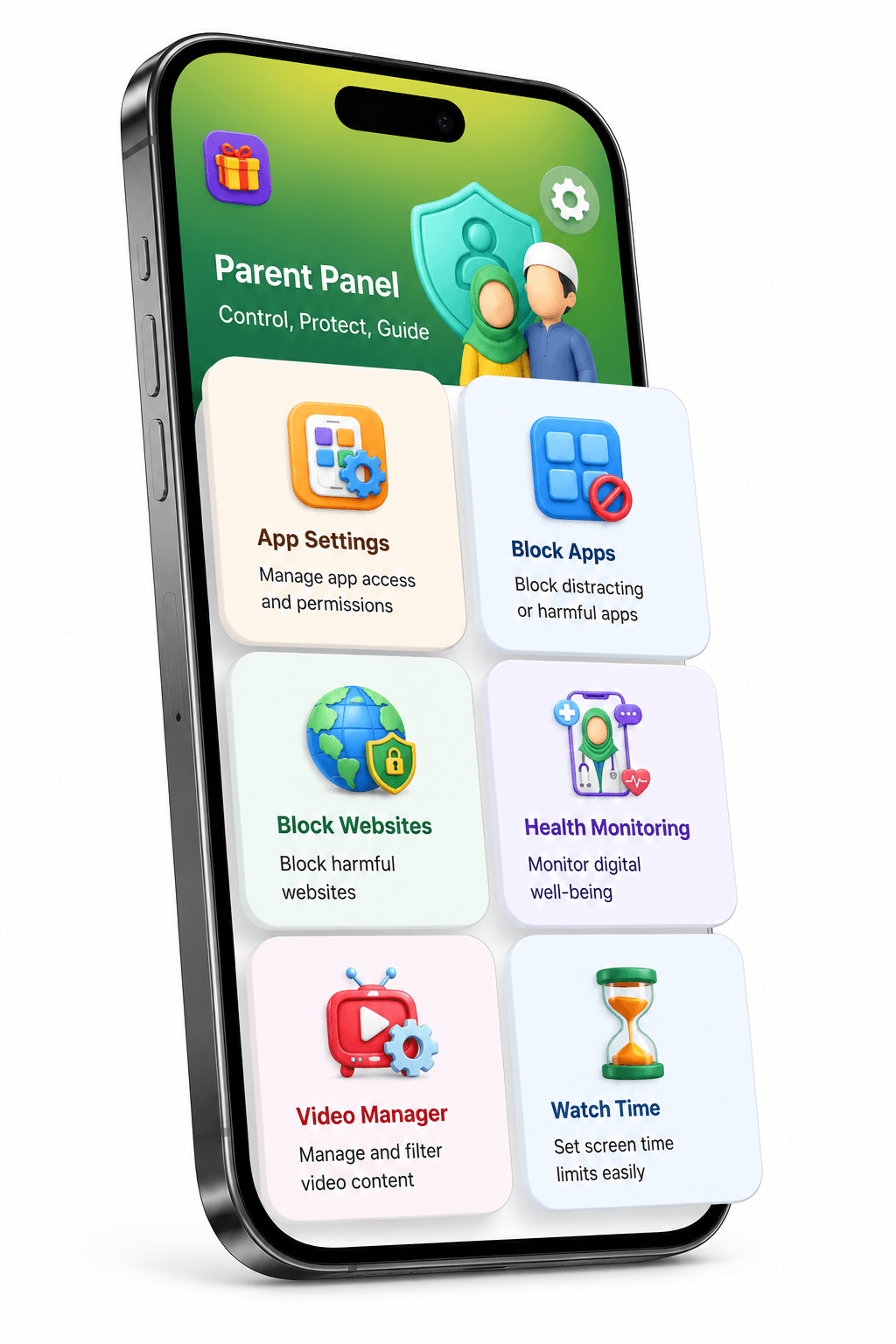
- Daily time limits that apply automatically
- App blocking and app-level rules
- Website filtering
- A bedtime or sleep mode
- Uninstall protection, so the controls cannot simply be removed
- Content filtering on video
- A parent PIN
If there is specific content or a specific app you want gone, we have step-by-step guides on how to block haram content on your child’s phone and how to block Roblox on your kid’s phone.
Setting a screen time limit on your child’s phone
Most of this takes under a minute to set up. Here is the whole process on a child’s phone, start to finish:
Caption: Setting a daily watch time limit in the Kahf Kids app.
Once the limit is set it applies automatically each day, and the parent PIN stops it being changed from the child’s side.
Kahf Kids: Screen-Time Control Built for Muslim Families
Kahf Kids was built around the same two things the AAP now emphasises, how long and what, with the content standards Muslim parents actually use.
| What the AAP asks parents to manage | What Kahf Kids provides |
|---|---|
| Content | 30,000+ curated videos, mufti-verified, ad-free, with Safe and Strictly Halal modes |
| Crowding Out | Watch Time Limit, Sleep Mode, App Blocker |
| Child | Age and content filtering, plus the option to add your own YouTube videos and playlists |
| Calm | Sleep Mode and bedtime controls that end the day without an argument |
| Communication | Parent PIN, App Guard, Website Blocker — the controls that make an agreement stick |
Why this approach is different
Most parental control apps manage how long. The AAP now says content and displacement matter more than the clock. Kahf Kids manages both: screen-time limits, content safety, and Islamic values in one place.
If you want to build a healthier device before you build a stricter one, start with our guide to the best educational and Islamic apps, videos and games for kids.
The Bottom Line
The goal was never to eliminate screens. It is to help children use technology in a way that protects their sleep, their health, their attention, their values, and their family life. The hour count is a starting point. What is on the screen, and what the screen is replacing, matters more.
Want more control over your child’s screen time and the content they see? Explore Kahf Kids.
Sources: WHO, Guidelines on Physical Activity, Sedentary Behaviour and Sleep for Children Under 5 · AAP, Understanding the New AAP Digital Media Guidelines · AAP, Screen Time Guidelines · HealthyChildren, The 5 Cs of Media Guidance · AAP, Screen Time for Infants
This article is general information for parents and is not medical advice. If you have concerns about your child’s development, sleep, or behaviour, speak to your pediatrician. Kahf Kids is our own product.